

On Substack I often comment on posts I disagree with. I like a good argument. It forces me to think about my own position. Can I defend it? Is there something I haven’t thought of? It’s also a good way to understand the positions of those who disagree.
That’s the ideal at least. It doesn’t always work out like that.
I came across a note the other day saying
It is fucking insane how many people just want to keep fucking with Russia. I really think people don’t comprehend how much Russia is not even close to being in a state of mobilization, that would equate to Total War.
These are the times when generations later will wonder what the lunatucs of the free and unthreatened world were thinking before they started WW3.
I understand the fear of things going nuclear, but then that’s a fear Putin is trying to stoke, and has been for some time. There’s a Wikipedia page outlining Putin’s nuclear blackmail during the invasion of Ukraine. It started on 27th February 2022 when he ordered Russia’s nuclear forces into a state of high alert.
Anyway, I replied.
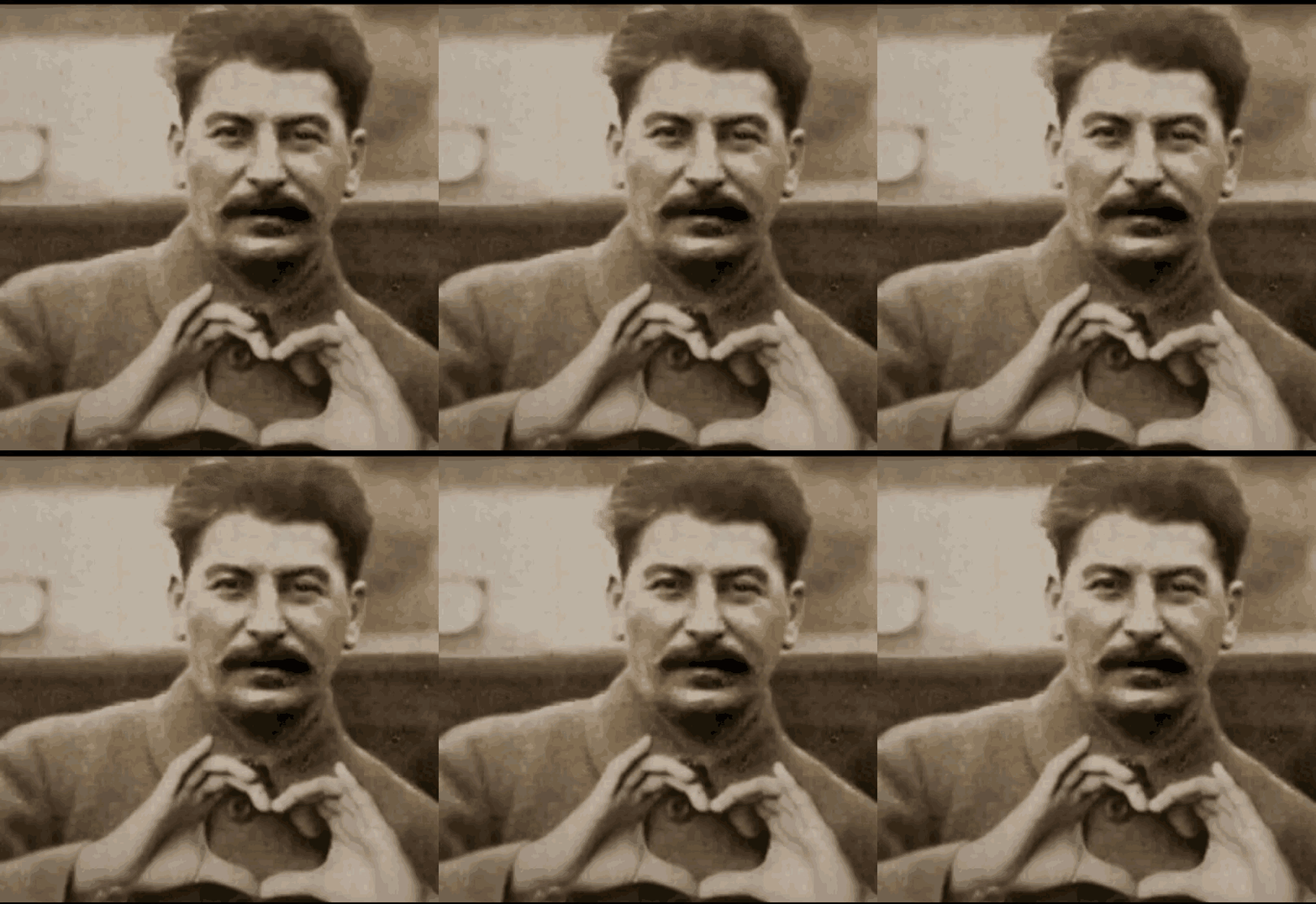
And got this response from the original poster, Laggy, whose profile picture is of Stalin making a love heart shape with his hands.
That sounds like an argument for appeasement, which of course made me think of the 1930s.
“That’s not the way it played out in the 1930s,” I said. “Appeasement resulted in us having to fight a bigger war against a stronger enemy.”
Though having said that, I recall a film I watched about how Chamberlain was unfairly maligned, suggesting that he bought Britain the time to re-arm. We weren’t ready to fight a war in 1938 but we were more ready by the end of 1939. Plus, the Munich agreement set up a red line for Hitler to cross, and when he crossed it six months later by invading the rest of Czechoslovakia it became clear he was someone who couldn’t be trusted to stick to any agreement. The only way to stop him was to fight.
“Man with small mustache bad”? Sounds a bit like the “orange man bad” quip Trump supporters use to deflect any criticism of Trump, suggesting the critic is being irrational.
I don’t think the power brokers in Britain wanted total war at all. The government seemed to be doing all it could to avoid going to war:
Appeasement was popular for several reasons. Chamberlain - and the British people - were desperate to avoid the slaughter of another world war. Britain was overstretched policing its empire and could not afford major rearmament. Its main ally, France, was seriously weakened and, unlike in the First World War, Commonwealth support was not a certainty. Many Britons also sympathised with Germany, which they felt had been treated unfairly following its defeat in 1918.
But once Germany took Czechoslovakia appeasement was seen to have failed and in August 1939 Britain and France signed a pact with Poland, promising to support it if it was attacked by another European power, which it was a week later.
“Negotiate a cease fire,” Laggy replied. “Polish sovereignty might have to be sacrificed to save tens of millions.”
Blitzkrieg
Once German troops were in Poland the only way you could have negotiated a ceasefire would have been by persuading the Poles to surrender, which they’d done by the end of September anyway, although by then both Britain and France had declared war on Germany.
The world adopted a new term to describe Germany’s successful war tactic: Blitzkrieg, or “lightning war.” The tactic consisted of staging a surprise attack with massive, concentrated forces of fast-moving armored units supported by overwhelming air power.
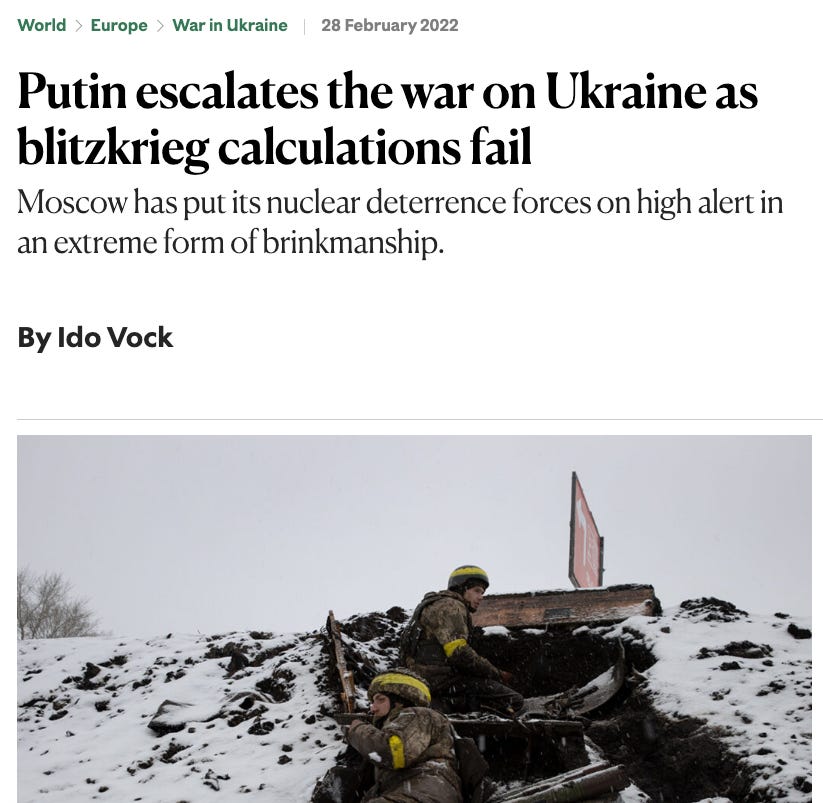
Is that the kind of thing Putin was hoping for in February 2022?
Had Britain and France not signed the pact with Poland, or had they refused to honour it and done what Laggy suggests, something along the lines of “OK, Adolf. You can have Poland but please don’t invade anywhere else or else” then what? Would that have been the end of it or would he have still gone into Belgium, Holland and France?
Stalin did in August 1939 sign a non-aggression pact with Hitler but a couple of years later Germany invaded Russia. It seems unlikely any similar pact Britain and France might have signed would have fared any better. Britain’s Foreign Secretary, Lord Halifax, did believe in 1940 that Britain’s best option was to negotiate a peace deal with Hitler. Churchill disagreed. In an address to the Outer Cabinet he said
if we tried to make peace now…we should become a slave state.
In April 2022 Zelensky told the UN that Russia wants to “turn Ukrainians into silent slaves”.
Assehole has entered the chat
Replying to “appeasing Putin will increase the danger”, Assehole says
This sounds very much like a version of the isolationist policy the US had in the ‘30s, before the Japanese attack on Pearl Harbor.
The isolationists were a diverse group, including progressives and conservatives, business owners and peace activists, but because they faced no consistent, organized opposition from internationalists, their ideology triumphed time and again.
I replied to Assehole
OK, we can’t know for sure what Putin is thinking. Even if he was in this room with me, I’d probably struggle to know what he was thinking. He was a spy after all, and he does appear to go by Vito and then Michael Corleone’s advice: “Never let anyone know what you’re thinking.”
Saying that, he does often tell us what he thinks
I am confident that true sovereignty of Ukraine is possible only in partnership with Russia. […] Together we have always been and will be many times stronger and more successful. For we are one people.
He said that in July 2021. What he didn’t say was that less than a year later Russia would be invading Ukraine. He may tell us what he thinks, but not what he’s thinking of doing about it. He generally doesn’t give away his strategy. Days before the invasion, when the Russian military was amassing on Ukraine’s border, Putin said they were purely defensive drills and not a threat to any other country. He’s been threatening to go nuclear for some time, setting up red lines that have been crossed.
I do trust experts, to some extent, though I recognise different experts say different things. There are people who know more about this than I do, though I don’t believe Assehole is one of them, except maybe when it comes to what regular Americans think.
Isolationism or internationalism?
Public opinion is divided, and there is now a strong strain of isolationism in the US. I think there are two arguments against it, one based on morality, the other on self-interest.
The moral argument is simply that when you are in a position to help others you should. The US is the richest country in the world. What it’s been spending on Ukraine amounts to around 0.35% of its GDP, so not that much and not as much as many European countries.
Then there’s standing up for your principles. A country shouldn’t just be able to invade another country and get away with it, but then if they do who’s going to stop them? When in 1990 Iraq invaded Kuwait the US led a coalition of 42 countries in order to evict the invading forces. However, initially the Americans were hesitant to get involved, “with the President publicly stating on the morning of Thursday 2 August that he was not contemplating intervention.” British PM Margaret Thatcher recalls a meeting with US President George H. W. Bush:
the President began by asking me what I thought. I told him my conclusions in the clearest and most straightforward terms. First, aggressors must never be appeased. We learned that to our cost in the 1930s.
But to whose cost? Perhaps to both the US and the UK. As well as the UK’s appeasement of Hitler there’s the US’s appeasement of Japan. When in 1931 Japan invaded Manchuria the US, whilst refusing to recognise Japanese Manchuria, didn’t impose any meaningful consequences on Japan nor did it assist China in retaking its territory.
In fact, US companies continued to supply Japan with the steel and petroleum it needed for its fight against China long after the conflict between the countries escalated into a full-scale war in 1937. But a powerful isolationist movement in the United States countered that the nation had no business at all in the international conflicts developing around the world.
The costly and disastrous interventions in Afghanistan and Iraq along with memories of Vietnam have bolstered the current isolationist movement. How did those conflicts benefit America? We need to stop worrying about other countries and put America first. That was the line in the ‘30s and it doesn’t sound so different now.

The US is geographically quite isolated from most of the world’s conflict zones, but in an interconnected world is that really much of a protection? It wasn’t on 9/11 and it wasn’t on 7/12 (1941).
Perhaps the US could have stayed out of the Second World War in Europe (if Hitler hadn’t declared war on them) and they would have been fine, though they would still have had to fight Japan, but they could have put all of their resources into that fight. Europe may have fallen to the Nazis, and maybe they would have defeated the Soviets as well, or maybe the Soviets would have defeated the Nazis. They’d have lost Western Europe as a trading partner and as strategic allies, and perhaps would still have faced either the Nazis, the Soviets or both in a cold war.
The case for appeasing Putin
One significant difference between those earlier appeasements and this one is that Putin has nukes. Hitler didn’t. Al Qaeda didn’t. Iraq didn’t. Maybe Putin’s nuclear threats are bogus, but maybe not. Do we really want to risk nuclear war for the sake of a country on the other side of the world that few of us could point to on a map?
I can understand that fear, and feel it, but then do we just allow a nuclear power to invade its neighbours and do what it wants? Let him have Ukraine but what if he then goes for Estonia, Latvia and Lithuania? Forget about NATO’s Article 5 and let him eat up those countries as well? Where do you draw the line?
If there is to be a negotiated settlement between Russia and Ukraine there may need to be some appeasement. Ukraine will probably need to give up some of its territory, and Zelensky appears to be well aware of that, though it’s not yet clear whether he’d be willing to permanently cede territory to Russia or whether it would just be a temporary acceptance of Russia’s illegal occupation that they would try to get back using non-military means.
If appeasement is the carrot, there are also sticks
Keith Kellogg, Trump’s pick for special envoy for the Ukraine war, said in June
We tell the Ukrainians, ‘You’ve got to come to the table, and if you don’t come to the table, support from the United States will dry up.' And you tell Putin, ‘He’s got to come to the table and if you don’t come to the table, then we’ll give Ukrainians everything they need to kill you in the field
Zelensky has suggested that the parts of Ukraine still under Ukrainian control be given NATO membership and therefore NATO protection. However, in an April article Kellogg said that in order to get Putin to the table
NATO leaders should offer to put off NATO membership for Ukraine for an extended period in exchange for a comprehensive and verifiable peace deal with security guarantees.
If Putin comes to the table but isn’t prepared to make any concessions, would a Trump administration be prepared to “give Ukrainians everything they need”? From what Trump’s been saying it doesn’t sound like it. Will Europe step up to the plate then?
I have more hope that Trump will be won over by Zelensky than that Europe will get its act together. Zelensky’s savvy. If anyone can convince Trump that supporting Ukraine would be good for Trump, he can.