

Polls suggest the Greens may have a slight edge, but people who haven’t seen the polls may vote Labour because they think they’re the only ones who can beat Reform. That’s what Labour’s campaign literature is saying.
If Reform UK do win, it will be on around a third of the vote, with the remaining two thirds likely split roughly equally between the two parties of the left, Labour and the Greens. When you only win a third of the vote, you can’t really say you were the choice of your constituents.
In 2011 we did have a choice of what kind of voting system we want. We were given the option of either sticking with the existing First Past The Post (FPTP) method or the Alternative Vote (AV) method. The Alternative Vote would have given people the option of choosing several candidates in order of preference, so instead of putting a single cross on a ballot paper you’d put 1 against your first choice, 2 against your second choice and so on.
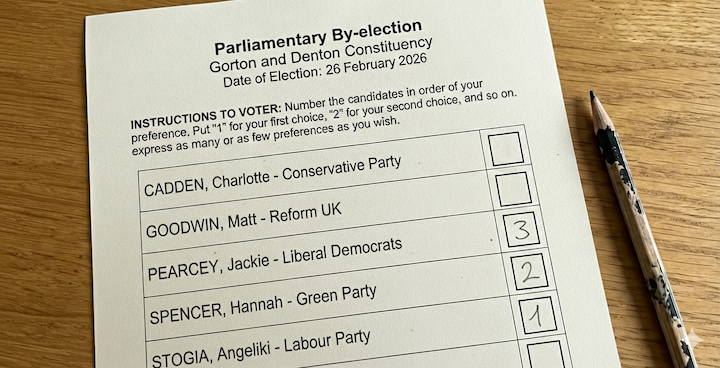
Votes would then be counted in a series of rounds, with each round eliminating the candidate with the fewest votes but rather than throwing away the votes for that candidate, the counters would look at the second preference of those voters. Those second preferences would then be allocated to the remaining candidates and again, the one with the fewest votes would be eliminated and so on, until you have a candidate with more than 50% of the votes. That candidate would be the winner.
I was on the phones at the Electoral Reform Society offices in 2011, trying to explain this system to people and trying to explain why it was better. Some people I spoke to worried that it would give too much power to small parties like the BNP who had been kept out of the running by FPTP. Others objected that they weren’t being given the option to vote for proportional representation (PR) so were going to sit the election out as a protest. Others were pissed off with Nick Clegg for jumping into bed with the Tories and wanted to give him a kicking by voting against what he wanted.
Only 42% of the electorate voted in the referendum and the No campaign won. In other words, we voted to stick with our current system, First Past The Post. That felt to me like we were asked “Do you want a bit more democracy with your elections?” and the British people said “No thanks. We’re good.”
That referendum result really made me despair, more so even that the Brexit vote five years later. It felt like a total no brainer. With Brexit, at least I could appreciate the Leave campaign had an argument. I thought it was flawed, and often based on untruths, but the no to AV campaign didn’t even seem to have an argument.
Thinking about it, there were actually quite a few similarities between No2AV and Leave. Both campaigns went for emotion over substance.
I was particularly pissed off with those who told me they wanted electoral reform, that they thought the current system was terrible, but they just didn’t think AV was any better. Sure, AV wasn’t PR. There were many ways you could criticise it. It wouldn’t necessarily make parliament any more proportional than it currently was, but it was clearly an improvement on the current system. Letting people mark their preferences 1, 2, 3, 4 etc. rather than just putting a single X against one of them was giving people more choice.
Another objection I heard was that it would lead to more coalition governments and coalition governments were bad. Remember, we had a coalition government in 2011, elected the previous year as no party had an outright majority in parliament. The No campaign made use of the unpopularity of the coalition, suggesting we’d get more of them if we went for AV. A number of people I spoke to said they liked that FPTP gave us a single party in government.
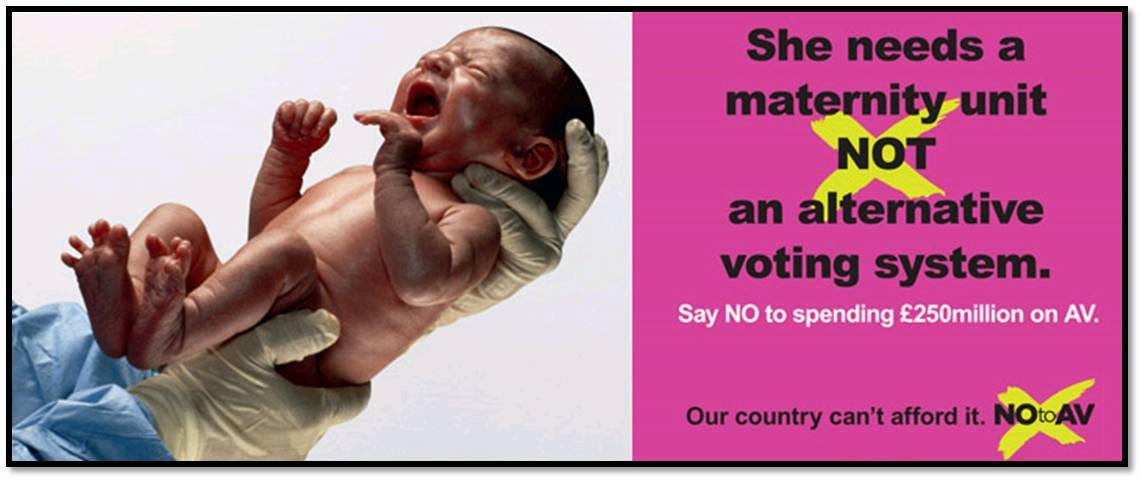
The campaign posters of the No campaign focused on the cost, £250 million they claimed, to switch our elections to AV. This was when we’d just been through the financial crisis and were suffering from austerity. There was a feeling among many that talk about how to vote in elections was not the highest priority facing the country.

If we had AV I think we could now be pretty sure Reform UK would have no chance of winning Gorton and Denton. They might pick up a third of the vote, and they might get second preferences from Tory voters and some of the smaller fringe parties, but the bulk of the electorate there appears to be on the left. Under AV it would be between Labour and the Greens.
In London we used to have a similar system when voting for mayor. You got two votes, a first choice and a second choice. This system never actually changed the winner, we would have got the same mayor under FPTP, but it meant you had a mayor who had actually received more than 50% support and it did encourage more friendly campaigning. Candidates didn’t want to piss off third parties too much as they may need the second preferences of those candidates’ supporters.
The change away from SV back to FPTP for mayoral elections, introduced by the last government, is now being reversed. It should be in place in time for the 2027 mayoral elections.
Due to the precedent set by the 2011 referendum, we’d probably need another referendum to introduce AV (or some other system) for our general elections. If Labour lose in Gorton and Denton, the pressure within the party for electoral reform, already strong, with 77% of the membership in support of PR, could strengthen.
2024 was the most distorted election result on record, delivering the most unrepresentative Parliament in British history.
Most voters got neither the person they voted for as their local MP (58%), nor the party they backed in government (66%).
The trouble with a referendum on PR is that there are so many flavours of PR, they’re not easy to explain, and also, any switch to PR would be a major change. New Zealand made the switch in the 90s via two referendums. Perhaps we’d need a referendum asking people if they want to move to a more proportional voting system that then lets parliament decide on which system to go for. That would require some trust in parliament though. There’d be accusations they’d come up with a rigged system to suit themselves.
The next election is closing in and there’s a risk we could end up with a Reform government getting elected on only a third of the vote, a similar share to what Labour got in 2024.
Starmer needs to come clean and state quite plainly that whilst Labour won fair and square through the existing system, a party winning two thirds of the seats in parliament from just over one third of the votes cast is not a good reflection of the views of the public. We need a better system. We should therefore introduce AV for the next general election and then the next parliament should decide on a system of proportional representation to be introduced in time for the following general election.
I wasn't here in 2011, so I missed out on the debate last time. I would certainly vote yes, but I am still rather put off by the complexity of AV. I wonder if the average voter might be intimidated by it. I think a single, second choice gives 90% of the benefits (keeps Reform out, for example) with half the complexity.