

In the last place I lived there was first a Google group and then a WhatsApp group for the neighbours on the estate. Most of the time these were used for messages like when bins are collected, hearing someone’s burglar alarm or a car alarm going off, suspicious characters walking around, a homeless person sleeping in the woods bordering the estate, people giving away items of furniture or, occasionally, hosting a garden party. There was some more intensive engagement when there was a proposal to build on a wooded part of the estate, which most residents objected to and we put our objections to the council’s planning committee.
I’ve just moved and was told by the agent that there’s a WhatsApp group or something for the street I’ve moved to but I’ve not yet met any of the neighbours so haven’t been invited to join it. This made me think that rather than people having to set up and run WhatsApp or Google groups themselves, they should instead be set up by the council. That way, any new resident could be informed of the group and be invited to join it as soon as they move in. A council could also ensure that such a group is accessible and could enable people to login using their council credentials, so what you’d use to login to the council’s website.
How would this work in practice?
This wouldn’t be a public debate forum, a consultation exercise or a place for campaigning. It would be closer to a shared noticeboard and conversation space for people who live near one another.
The neighbourhood groups I’ve been on, both for the same neighbourhood, seemed to work very well. People were polite and friendly, but then maybe I was fortunate in living in a decent neighbourhood. People could get into arguments, they could be abusive, or could use a group to promote themselves or their business interests, but I think when people have to use their own names they’re likely to be more respectful. They can’t hide behind pseudonyms like they can on most social media sites.
If there are neighbourhood disputes, people who are anti-social, say playing loud music late at night, then perhaps it’s better to have these disputes out in the open. If someone playing loud music gets a knock on their door from one of their neighbours, they may just think that one neighbour is being overly sensitive whereas if they see that many of their neighbours are also bothered by their loudness that may carry more weight. Being able to raise a contentious issue in an online forum may reduce the risk of escalation, though if someone is having a loud party it’s unlikely they’ll be logging into the neighbourhood forum. But your neighbours may well be.
In some neighbourhoods a large proportion of people may speak a language other than English as their first language. Automated translations are pretty good though, so the app or website could let people set their preferred language in order to see all content in that language. There are risks of mistranslation of course.
Each neighbourhood group would need to be private, only visible to its members. People posting under their own names and possibly displaying their addresses, though those things would need to be optional. Some may be wary of giving out such information, particularly to start with, so people should have the option of not showing their address and either just using their first name or a pseudonym.
What is a neighbourhood?
Sometimes it might be quite obvious, like where I used to live was on an estate of 46 flats and houses, though there was a street of about ten houses leading up to the estate and I don’t believe they were included in the neighbourhood group. The people in those houses would have faced many similar issues though, like when there were events in the local park and we experienced noise and visitors using the street and the estate as a car park. Neighbourhoods will often merge into one another so it would make sense to allow their online groups to merge in some way as well. Perhaps by default a post to a group would only go to members of that particular group but a checkbox could allow someone to also post to neighbouring groups.
Why don’t councils do this?
One reason is they’re not required to, and with a shortage of funds councils tend to focus on the services they’re required to provide. Plus there are all sorts of legal risks councils would run if they tried to set up neighbourhood groups.
Which is a shame because putting people in touch with their neighbours, encouraging communication and mutual support is a public good. It feels like it’s something councils should be doing.
There are even legal difficulties with using someone’s council login credentials to let them login to a neighbourhood forum. I was thinking I ought to be able to use my council login the way I use my Google or Apple accounts to login to other council sites and apps but that would be against the law.
So we would need to change the law.
Firstly, we’d need to define neighbourhood digital forums as a legitimate local government function. Currently, “councils are responsible for social care and provide some aspects of transport, housing, and education. They are also in charge of a range of neighbourhood services including libraries and waste collection.” We’d need to add neighbourhood forums to that list of responsibilities, perhaps framing it in a more general way, like neighbourhood or community cohesion, so online neighbourhood forums could be part of it but not the whole thing.
Secondly, we’d need to authorise residency verification for civic participation purposes. This would allow data held on the council tax register or the electoral roll to be used to verify someone’s address when logging into a neighbourhood forum.
Thirdly, neighbourhood forums would need to ensure the law would not treat a council-run neighbourhood forum the same way it treats Facebook for instance when it comes to moderation. The council could not be treated as a publisher in the same way as commercial platforms are.
The Local Government Association has a page on community cohesion. This doesn’t explicitly talk about online neighbourhood forums, perhaps in part due to the legal barriers for such things, but it does talk quite a bit about informal face-to-face gatherings of neighbours.
Why bother?
When people can already set up WhatsApp, Google, Facebook or whatever groups themselves, why go through all this hassle of changing legislation so councils can do it? If it ain’t broke, don’t fix it.
Well, it’s now over a month since I moved into my new place and though the agent told me there was a neighbourhood group, I’ve not yet been invited to join it. I’ve only met one of my neighbours, someone two doors down, and that was only because a package for her was delivered to my address. I didn’t really speak to her. I suppose I could knock on the doors of the neighbours and introduce myself, but I’m a bit shy. If, as soon as you moved into a new place, you were automatically invited to the neighbourhood group that would benefit people like me. It would also benefit people living in places where no one has taken it upon themselves to set up a group, and perhaps those are the sorts of neighbourhoods that most need them.
Councils have role to play in building cohesive communities, says the Local Government Association. “No one can impose cohesion on a community, but councils want to do all that they can to create the conditions in which local communities can flourish.”
If you’ve connected with someone in an online group, or just read something they’ve posted, it’s likely going to be a bit easier to speak to them in person if you happen to bump into them, or to go and knock on their door and introduce yourself. In person meetups become more likely when people have already met virtually.
Loneliness and belonging
The World Health Organization has declared loneliness to be a pressing public health threat and has called on all countries to prioritise social connection. According to data from the Office for National Statistics, over 7% of the population say that they are always or often lonely, with people under 30 being the most lonely age group.
Putting neighbours in touch with one another via an online group is not going to solve this problem, and in a study by Harvard’s Making Caring Common project, respondents blamed technology as the number one cause of loneliness so yet another piece of software might sound like the last thing we need. But technology is a very broad term. Too broad to be meaningful. There is technology that replaces face-to-face interaction but there is also technology that enables it. A technology that connects neighbours is one that can promote face-to-face connections. Even without face-to-face connections, knowing who your neighbours are can promote a sense of belonging. This is reflected in ONS research, which finds that people who feel connected to their local area report lower loneliness.
Looking at the factors associated with loneliness, the ONS highlights several that are directly related to neighbourhood connection:
Renters reported feeling lonely more often than homeowners.
People who feel that they belong less strongly to their neighbourhood reported feeling lonely more often.
People who have little trust of others in their local area reported feeling lonely more often.
A local social network is probably not going to promote deep friendships, although it might. What it is more likely to lead to is familiarity. Seeing the same names, recognising who lives nearby, knowing who to ask about a lost cat or a broken fence. Small interactions that reduce the sense of being invisible. This kind of everyday social awareness can matter even when people rarely meet in person.
I grew up on a street where I played with the neighbouring children and then, when older, went to the village pub. I remember going to the shops with my mum in the 1970s, which would involve going to the village butcher, the green grocer, the bakery, the fish monger etc.. Each shop keeper knew my mum and knew me, and my younger brothers when they came along. Those shop keepers weren’t by any means close friends. These “how are you today, Mrs J?” interactions were pretty superficial, but they were constant and, to me as a child, reassuring. We were known and we were part of a community. Since moving I’m not sure I still feel like I’m part of a community.
Shopping was a social activity then whereas now we’re likely to go to a supermarket and use an automated checkout till. The only interaction with a human is when you need approval for buying alcohol or there’s an unexpected item in the bagging area. Or you’ll do an online order and have a brief interaction with a delivery driver as they bring your shopping to your front door. There are still smaller shops where you may have some personal interaction, but far less so than was once the case. Pubs are closing and social media feels increasingly anti-social, filled with angry people or bots hiding behind pseudonyms.
Many of my parents’ closest friends were our neighbours, most often the parents of other children on the same street. Mobile phones have increased connection to people who are geographically distant, people we would previously have had to write a letter to or, if we wanted to phone them, we’d be paying for a long distance call. That has made many of us feel less need to connect with our neighbours.
Cats
Our cat went outside for the first time today since we moved in. I would have liked to have posted a message saying if you see this cat and she looks lost, please let me know. I did that at the last place on the neighbourhood group when she went missing.
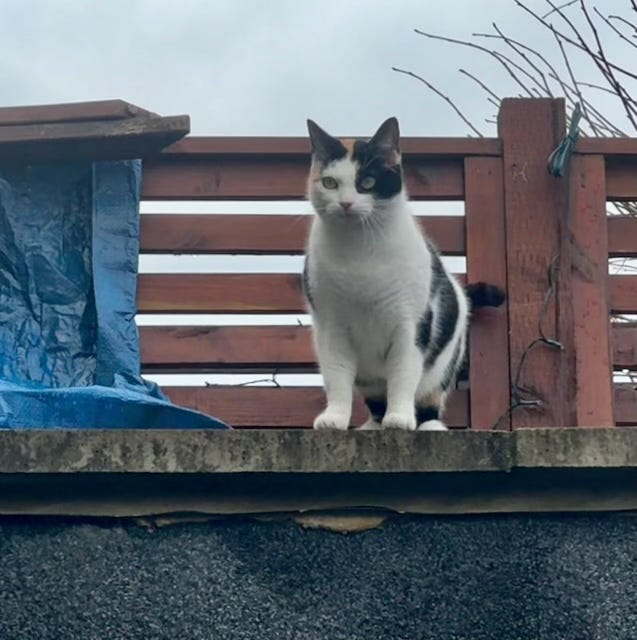
That may seem like a small thing, but we all have small things like that. They can connect us and make us feel like we’re part of a community, which I would say is a pretty big thing.